TLDR
- Both products can roam across many countries.
- eSIM delivery is faster and has no loose card.
- Physical international SIM supports more old phones.
- Some international cards include a long-term number.
- Country lists and rates matter more than the format.
Delivery is the clearest difference
A travel eSIM can arrive in an app or email minutes after payment. The traveler downloads it over Wi-Fi and keeps the physical home SIM installed. There is no shipping deadline or tiny card to store.
An international SIM card has to be bought in a shop or delivered before departure. You insert it in the tray, which can be easier than scanning a code for people familiar with physical SIMs.
Digital delivery is not permission to rush. Confirm the seller, read the activation date, and follow uPhone’s eSIM installation guide. For a card, test it before leaving while support is easy to reach.
The phone may choose the format for you
Older phones often have a SIM tray but no eSIM hardware. Some newer models sold in certain markets have eSIM only. Dual-SIM design also varies by region.
Check the exact model with uPhone’s compatibility checker. Both products normally require a carrier-unlocked phone and compatible local radio bands.
A physical card can move to another unlocked phone during a breakdown. An eSIM transfer depends on the provider and may require a new profile. On the other hand, an eSIM cannot fall out or be misplaced during a tray swap.
Keep the tray and card safe
Use the correct tool and do not open the tray on a plane seat or crowded platform. Store the home card in a labeled case rather than taped to paper.
International products differ widely in calls and coverage
Many travel eSIMs are data-only, though some include voice or texts. International physical SIMs may provide a permanent foreign number, incoming-call options, and pay-as-you-go rates. Read country-specific charges carefully.
Neither “global” label means every country. A product can exclude small islands, territories, ships, or remote regions. It may also use only one partner in a country.
Review eSIM partners through uPhone’s coverage guide. For a physical SIM, ask the seller for the same detail. The network agreement affects 5G, priority, and rural reach.
One-time bundles and reusable credit suit different travelers
Travel eSIMs often sell a fixed amount for a fixed period. This makes the maximum cost clear. You can add another country or regional profile without waiting for a new card.
International SIM cards often focus on reuse. A frequent traveler keeps the card and number, tops up credit, and pays country rates. Credit inactivity rules or annual fees can reduce that benefit.
Compare plans in uPhone’s data plan guide. Add shipping, card price, activation, tax, conversion, top-ups, and expiration. The cheapest gigabyte is not useful if it expires between trips.
The two formats fail in different ways
A physical SIM can be removed from a stolen phone and used elsewhere unless the line and account are protected. A SIM PIN helps, though forgetting its recovery code can lock the owner out.
An eSIM stays tied to the device hardware, but a weak provider account can expose orders or transfers. Secure the account and email with unique passwords and strong multi-factor authentication.
If the phone is lost, mark the device lost and contact the provider for either format. Do not assume an eSIM disappears after remote erase or that removing a card cancels a subscription.
Choose digital convenience or physical portability
Pick a travel eSIM for an immediate trip, a phone that must keep its home SIM, or a route where you want to add packages by app. It also avoids international shipping.
Pick an international SIM card for an older phone, a need to move service easily between devices, or a long-term international number with rates you understand.
Frequent travelers can use one as backup for the other, but choose products on different networks. Two services using the same roaming partner can fail together.
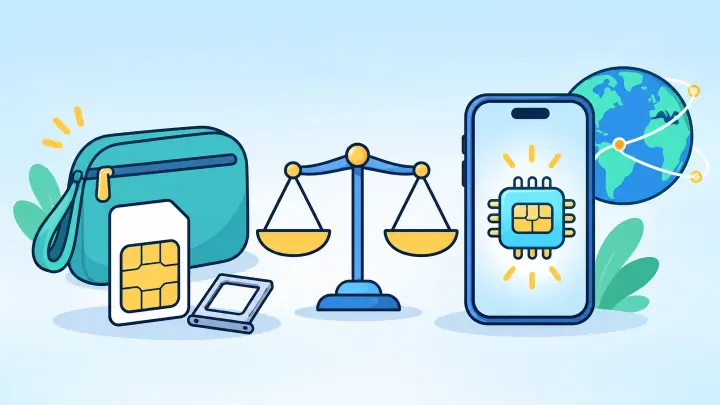
Travel eSIM wins on delivery while an international SIM card wins on physical portability
Both can be roaming products with similar coverage and speed. Their real differences are how the profile arrives, which phones accept it, and how easily it moves to another device.
Read the country list, partner networks, number features, validity, and full cost. The best profile is the one that matches the route rather than the one with the broader marketing name.