TLDR
- eSIM depends on a ground cellular network.
- Satellite phones connect directly to a satellite system.
- Sky view terrain and local rules affect satellite use.
- Emergency equipment needs practice before departure.
- Carry a device matched to the route’s real risk.
Cell towers and satellites cover different gaps
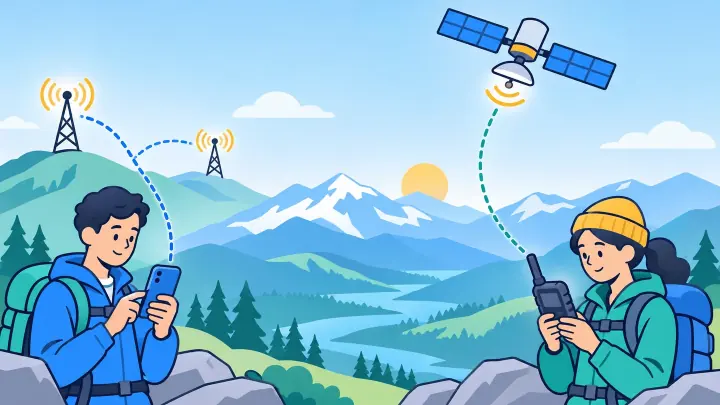
A travel eSIM registers on a local carrier. It can work well in towns, along major roads, and in popular parks while becoming useless beyond the last tower. A coverage map is an estimate, not a rescue promise.
Satellite phones talk to a chosen satellite network. Depending on that network, they can cover oceans, deserts, polar areas, and backcountry routes without cell towers. Coverage is not identical across satellite systems.
Start with uPhone’s eSIM coverage guide, then compare the satellite operator’s official map for every part of the route. Ask local guides about valleys and canyons where terrain blocks the sky.
The eSIM handles data while the satellite phone handles reach
Cellular data supports web pages, rich maps, photos, cloud files, app calls, and fast messaging at normal smartphone speeds. It is the better daily tool whenever service is present.
A satellite phone focuses on voice and basic messages. Calls may have delay, and data can be slow or expensive. It is valuable because a person can speak with emergency help or a trip contact when no mobile network exists.
Normal emergency numbers may work differently over satellite systems. Save the correct emergency and coordination numbers for the country and service before leaving.
One device cannot guarantee a rescue
A working call is only one part of a response. The caller must know the location, problem, weather, group condition, and local rescue route.
A satellite phone needs the right place and setup
Buildings, caves, dense cover, steep valleys, and vehicle roofs can block the signal. The antenna may need to point or extend in a certain way. A traveler should practice outside with the exact model.
Countries can restrict satellite-device import or use. Check official rules and permits for every border. Do not assume that emergency intent makes an unapproved device legal.
Cold weather shortens battery life. Keep spare power protected and follow airline battery rules. Store the device where it remains reachable after a fall, not buried at the bottom of a pack.
Renting can make sense for one demanding trip
Satellite costs can include the handset, rental days, insurance, activation, airtime, incoming calls, messages, and shipping. A late or damaged rental can add large fees.
A travel eSIM costs far less and offers more data. Compare cellular packages in uPhone’s data plan guide, but do not buy a larger bundle as a substitute for missing coverage.
For a guided or group trip, ask whether the operator carries shared satellite equipment and who controls it. One device with a leader may not help a person who becomes separated.
Build communication into the route plan
Leave a written itinerary, check-in schedule, vehicle details, and overdue response plan with a reliable contact. Agree on what a missed check-in means and when that person should call authorities.
Carry offline maps, coordinates, a compass or navigation backup, first-aid supplies, and enough power. Know how to state latitude and longitude. Communications do not replace route skills or weather decisions.
Install cellular service before departure with uPhone’s eSIM setup guide. Test the satellite phone under open sky and make one permitted call.
Match equipment to distance consequences and rescue time
For a city trip or well-traveled road with broad mobile coverage, eSIM is enough. For a remote lodge with Wi-Fi and a staffed emergency plan, the operator’s systems may cover the gap.
For solo wilderness travel, offshore work, remote driving, or places where a breakdown can become life-threatening, a satellite phone or appropriate emergency satellite device may be necessary. Seek advice from local authorities and experienced guides.
Confirm the smartphone itself through uPhone’s compatibility checker. Then treat satellite equipment as a separate system with its own subscription and rules.
Use eSIM for connected areas and a satellite phone for remote voice reach
These products are not direct substitutes. The eSIM offers rich, affordable data near cell towers. The satellite phone sacrifices speed and price for the ability to call far beyond them.
Map the dead zones, understand local law, practice with the equipment, and leave an emergency plan. On serious remote trips, carrying both creates useful layers rather than duplicate service.