25 eSIM Facts Every Traveller Should Know
Compatibility data, real cost comparisons, security features, and everything else about eSIM technology — the facts that help you travel smarter.
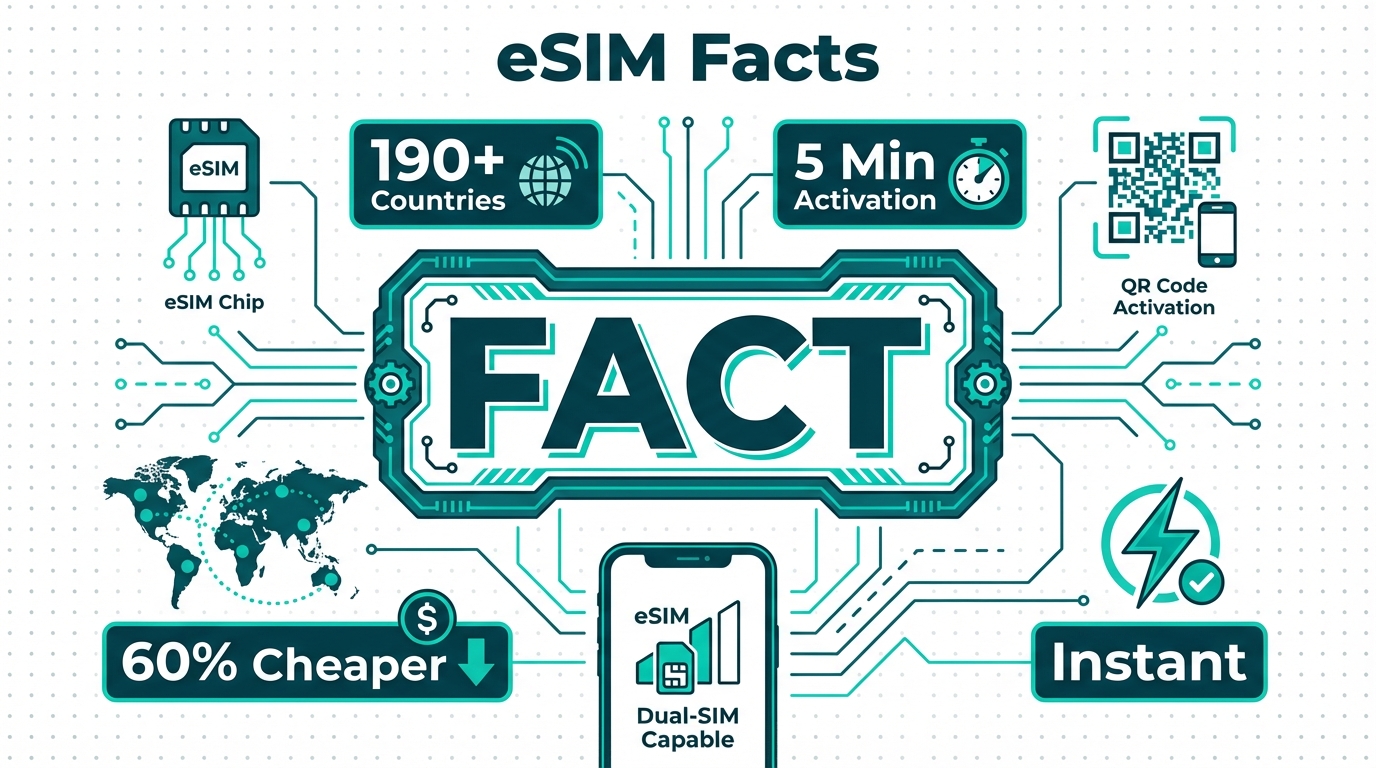
eSIM stands for embedded SIM — it's built permanently into your device
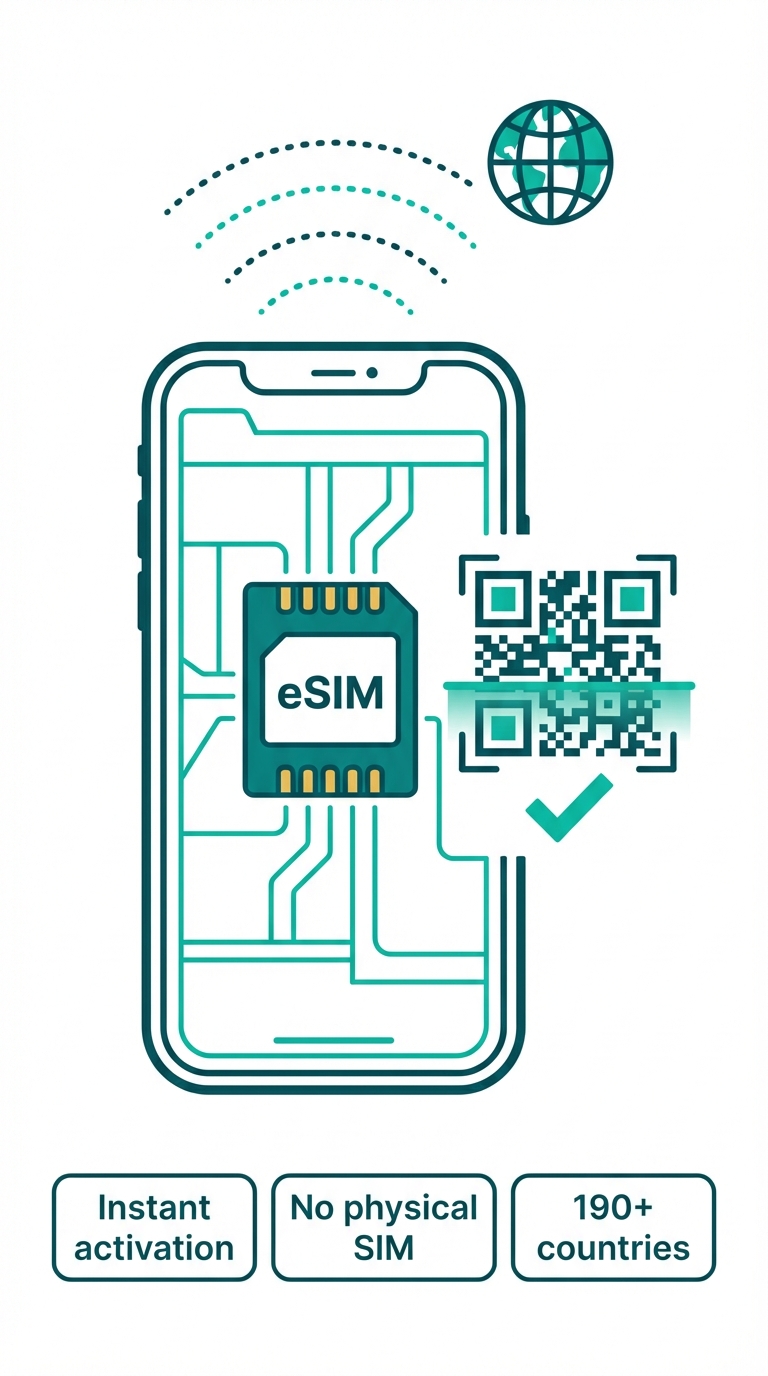
An eSIM is a small chip soldered directly onto your phone's motherboard. Unlike a physical SIM card, it cannot be removed, dropped, or lost. It stores carrier profiles digitally and can be reprogrammed over the air, just like updating an app.
What is an eSIM? →The eSIM standard was developed by the GSMA and launched for consumer devices in 2016
The GSMA (Global System for Mobile Communications Association) created the eSIM specification — the same industry body that governs global mobile standards. Consumer eSIM arrived in the Apple Watch Series 3 in 2017, with smartphones following in 2018.
iPhones have supported eSIM since the iPhone XS and XR (2018)
Apple was the first major phone manufacturer to bring eSIM to smartphones. Every iPhone from XS/XR onwards supports eSIM, with up to two simultaneous eSIM profiles. The iPhone 14 US model went further — it removed the physical SIM tray entirely.
The US iPhone 14 is eSIM-only — no physical SIM tray
Apple's boldest eSIM move: the iPhone 14, 14 Plus, 14 Pro, and 14 Pro Max models sold in the United States have no SIM card slot at all. All connectivity is handled by eSIM. International models still have a physical SIM slot.
eSIM activation takes under 5 minutes via a QR code scan
Once you purchase an eSIM plan, you receive a QR code. Open your phone's Settings, tap "Add eSIM", scan the code, and you're connected. Most " ~ brand_name ~ " plans activate in under 3 minutes with no app required. Compare that to finding a local SIM shop, waiting in line, and providing ID.
eSIM plans are typically 40–60% cheaper than airport SIM cards
Airport SIM cards carry a location premium — you're paying for convenience and captive audience pricing. eSIM plans sold online have no retail markup, no physical distribution costs, and no airport rent. A 5 GB plan for Japan bought at Narita costs $35–50. The same plan on uPhone: $12–18.
Browse eSIM plans →You can store up to 20+ eSIM profiles on a single iPhone (iOS 17+)
Each eSIM profile is a different carrier plan stored digitally on your device. You can collect plans from different countries and switch between them without downloading anything new. Older iPhones support at least 8 eSIM profiles stored simultaneously.
eSIM supports dual SIM — use your home number and travel data at the same time
With eSIM + physical SIM, your home phone number stays active for calls and texts (important for two-factor authentication and business contacts) while your eSIM provides affordable local data. No more telling everyone "I'm on a different number while travelling".
eSIM dual SIM setup →Over 190 countries have at least one eSIM-compatible carrier
eSIM coverage has expanded rapidly. In 2019, fewer than 50 countries had consumer eSIM support. By 2024, 190+ countries have compatible carriers. uPhone eSIM plans cover 150+ countries via carefully selected local network partnerships.
As of 2024, over 90% of new flagship Android phones include eSIM support
Samsung Galaxy S series, Google Pixel, Sony Xperia, OnePlus, and most flagship Android devices now ship with eSIM. Mid-range Android phones are catching up quickly. Budget and entry-level Android devices are the main exception — check your model before purchasing an eSIM plan.
Check device compatibility →Google Pixel phones have supported eSIM since the Pixel 2 (2017)
Google was an early eSIM adopter alongside Apple. Every Pixel phone from the Pixel 2 onwards supports eSIM. The Pixel 7a and later models support dual eSIM — two simultaneous eSIM profiles with no physical SIM required.
Samsung Galaxy S series has supported eSIM since the Galaxy S20 (2020)
Samsung introduced eSIM across the Galaxy S20 lineup in 2020 and has included it in every flagship S-series model since. The Galaxy Z Fold and Z Flip series also support eSIM. Older Samsung models (S10 and below) typically do not support eSIM.
eSIM cannot be physically stolen from your device
Physical SIM cards can be removed by a thief or in a SIM-swap attack. An eSIM is soldered inside the phone with no accessible card slot. This removes one avenue of physical security attack. Carrier credentials are stored in a secure eUICC (embedded Universal Integrated Circuit Card) chip.
You can remotely delete an eSIM profile if your phone is lost or stolen
eSIM profiles are tied to carrier accounts, not the physical chip. If your phone is lost, contact your eSIM provider and they can remotely deactivate the profile. This is not possible with a physical SIM card, which would simply work in any compatible device.
eSIM QR codes are single-use — scanning them twice may fail
Each QR code provided for eSIM activation is a one-time token. Once scanned and confirmed, the code is consumed. If you need to reinstall the profile (e.g., after a factory reset), you need to contact your provider for a new QR code. Store a screenshot before scanning.
You can purchase and activate an eSIM plan while airborne using inflight Wi-Fi
Since activation is entirely digital, you can buy a uPhone eSIM plan on the plane and have it ready before landing. Connect to inflight Wi-Fi, complete the purchase, scan the QR code, and your eSIM is configured — ready to connect to local networks the moment you land.
Browse eSIM plans →eSIM data-only plans work for voice via Wi-Fi calling
Most eSIM travel plans are data-only — they don't come with a local phone number. But with Wi-Fi calling enabled (standard on iPhone and most Android flagships), you can make and receive calls on your home number over your eSIM's data connection. No separate voice plan needed.
eSIM profiles are stored in a certified eUICC chip — same security standard as physical SIM
The eUICC (embedded Universal Integrated Circuit Card) stores eSIM profiles with the same ETSI and 3GPP security certifications as physical SIM cards. Carrier credentials are stored in tamper-resistant hardware, not exposed in device storage.
A 1 GB eSIM plan for Japan typically costs $4–8 vs $15–25/day in roaming
International roaming charges from major carriers are among the worst value in mobile data. A week in Japan on roaming could cost £100+. A dedicated eSIM plan for the same trip: $10–20. For frequent travellers, eSIM savings easily pay for the cost several times over.
Browse eSIM plans →eSIM works perfectly with a VPN — they operate at different network layers
Your eSIM provides the cellular data connection (Layer 2/3). A VPN app encrypts the traffic flowing over that connection (Layer 4+). They don't conflict — in fact, pairing a uPhone eSIM with a VPN is the recommended setup for travellers who need both fast local data and private, unrestricted browsing.
eSIM + VPN setup →The number of eSIM-compatible device models grew from under 100 in 2019 to over 1,000 in 2024
eSIM adoption has accelerated dramatically. What was once a premium-only feature has moved rapidly into mid-range devices. Smartwatches, tablets, laptops, and even some IoT devices now include eSIM support, dramatically expanding the ecosystem.
Most prepaid eSIM plans auto-stop when data runs out — no surprise bills
Unlike roaming, where usage can silently rack up charges until you notice, prepaid eSIM plans have a hard cap. When your 5 GB is gone, the plan stops — or notifies you to top up. You're always in control of what you spend.
eSIM data plans reset from midnight local time or from activation — check your plan
Daily eSIM plans (e.g., unlimited data per day) typically reset at midnight local time. Validity-period plans (e.g., 10 GB for 30 days) run from the moment of first use or from activation. Always check the plan details — uPhone shows this clearly at checkout.
Some carriers allow eSIM transfer to a new phone — saving your plan when you upgrade
If you upgrade your phone mid-trip, most major eSIM providers allow profile transfer. The process varies: some use QR re-issue, others use device-to-device transfer. Apple's eSIM Quick Transfer lets you move profiles between iPhones wirelessly. Contact your provider before wiping your old device.
Transfer eSIM to new phone →uPhone eSIM plans work in 150+ countries with local network rates
Instead of roaming agreements that route your data internationally, uPhone uses local network partnerships in each country. Your data travels on local infrastructure — lower latency, faster speeds, and prices that reflect actual local data costs rather than international markup.
Browse eSIM plans →