VPN Legality by Country
Where VPNs are fully legal, where they're in a grey zone, and where they're banned — with practical guidance for travellers in 2026.
VPNs are legal in most of the world
In more than 190 countries, VPNs are completely legal and widely used — by multinational corporations to protect remote workers, by journalists to protect sources, and by ordinary people to maintain privacy online. The technology itself is neutral.
A handful of countries — mostly authoritarian regimes — restrict or ban VPN use in an attempt to control what their citizens can access online. These countries make the news precisely because they are the exception, not the rule. Even in these places, travellers routinely use VPNs without incident.
In most restricted countries, VPN bans target providers (i.e., you can't operate a VPN business without government approval) rather than end users. Tourists are almost never prosecuted for personal VPN use — but the risk is not zero.
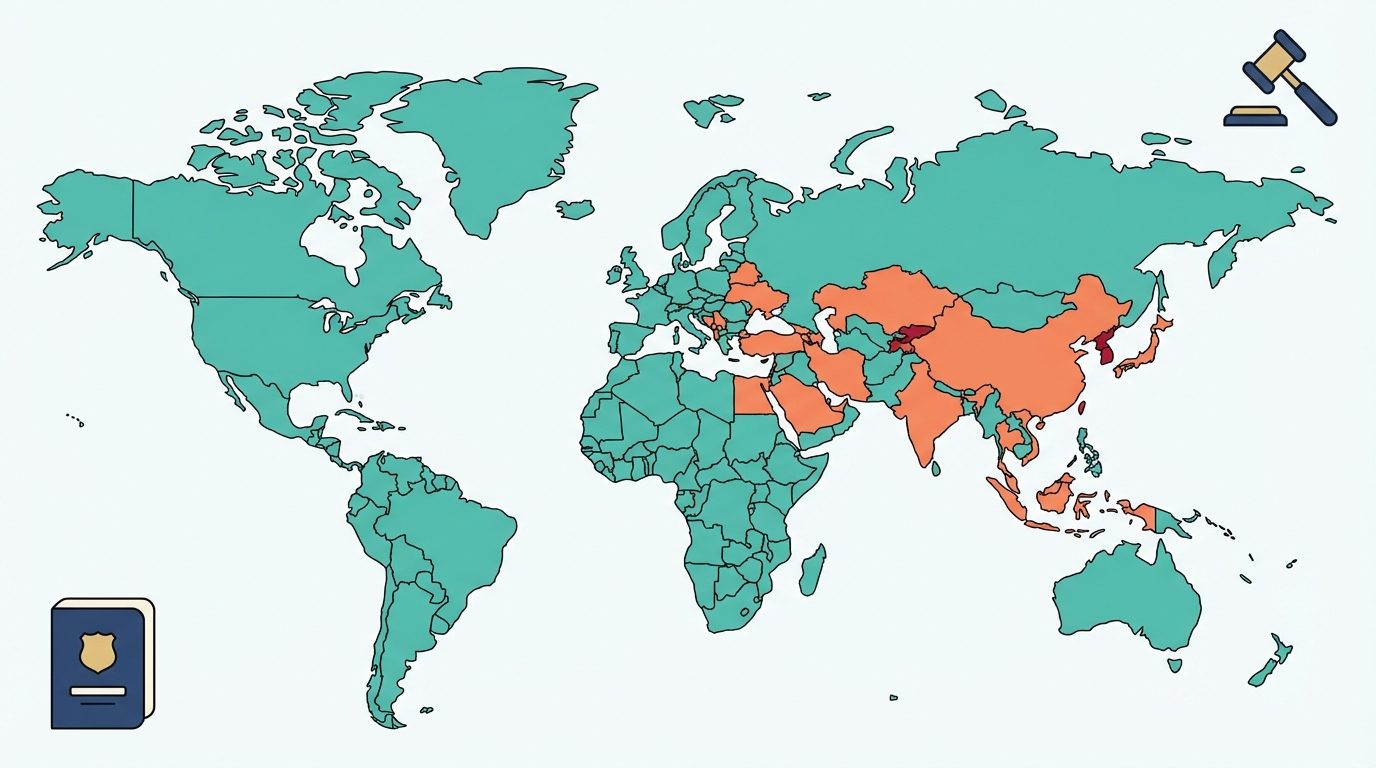
Countries where VPNs are banned or heavily restricted
These countries have laws that either explicitly ban VPN use or require VPN providers to hold government approval (which effectively bans all reputable services).
Countries where VPNs are restricted or in a grey zone
These countries allow VPN use in principle but with significant caveats — often banning use for specific purposes (bypassing government censorship, accessing VoIP services) or blocking VPN provider websites.
| Country | Status | Enforced vs tourists? | Tourist risk level |
|---|---|---|---|
| 🇦🇪 UAE | Illegal for bypassing censorship or using VoIP | No known tourist cases | ⚠️ Low–medium |
| 🇹🇷 Turkey | VPN sites blocked, use is widespread | Virtually never | ✅ Very low |
| 🇧🇾 Belarus | VPN use restricted since 2022 | Occasionally | ⚠️ Low–medium |
| 🇴🇲 Oman | Illegal for bypassing censorship | Rarely | ✅ Low |
| 🇸🇦 Saudi Arabia | Regulated — ISPs block VPN sites | Rarely, for individuals | ✅ Low |
| 🇵🇰 Pakistan | VPN registration required by law since 2020 | Rarely | ✅ Low |
Where VPNs are completely legal
The vast majority of the world — including every country most travellers visit — has no restrictions on VPN use whatsoever. VPNs are considered standard privacy and security tools used by businesses and individuals alike.
Note: India requires VPN providers to retain user logs for 5 years and report to the government on request — which caused NordVPN and ExpressVPN to remove their Indian servers. VPN use itself remains legal.
In countries that restrict VPNs — including China, Russia, Iran, and the UAE — VPN provider websites are blocked. The App Store and Google Play may also restrict VPN app downloads when accessed from these countries. Install and test your VPN before you board the plane. This is non-negotiable.